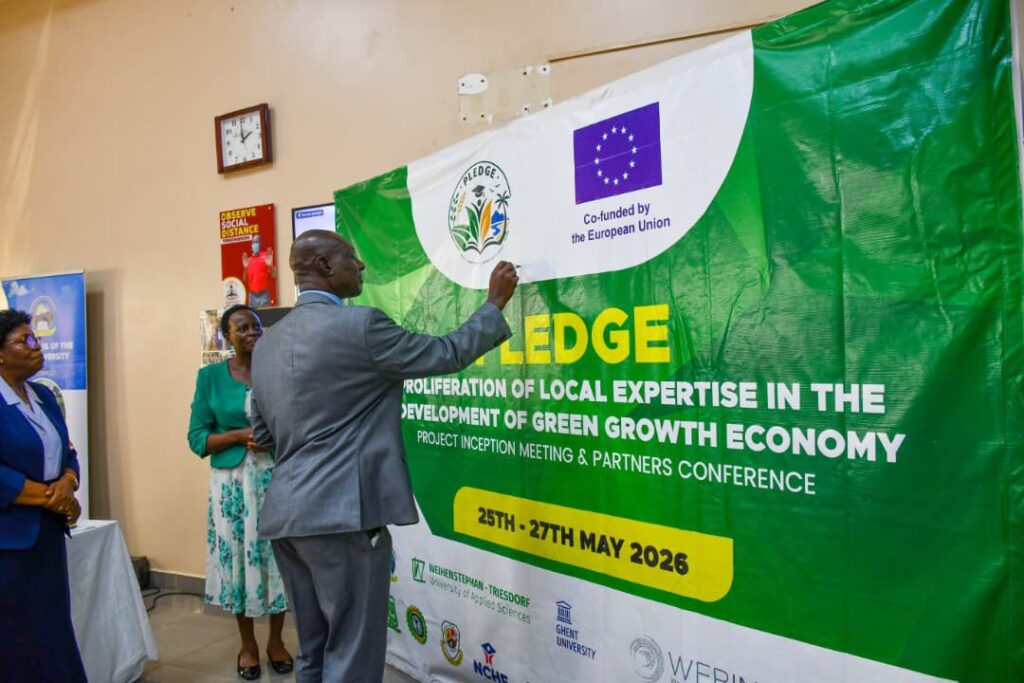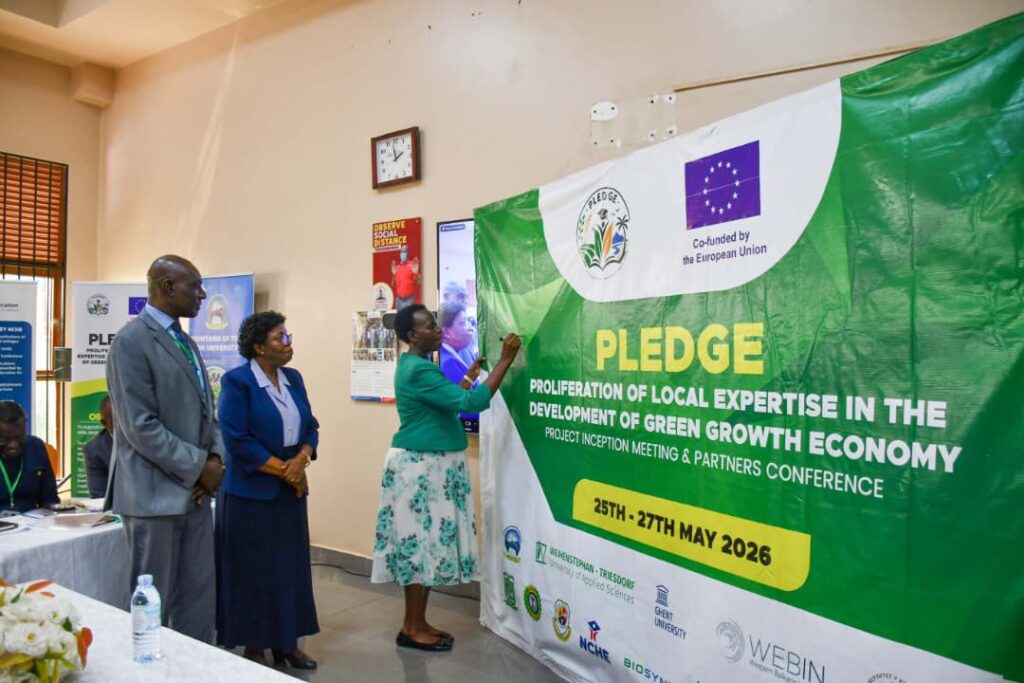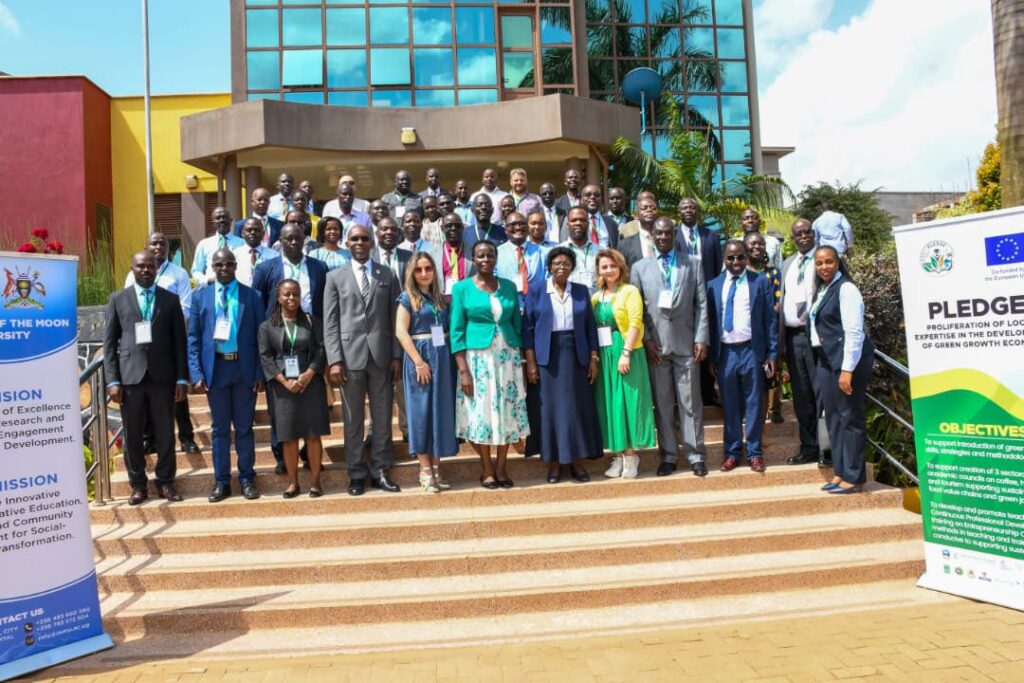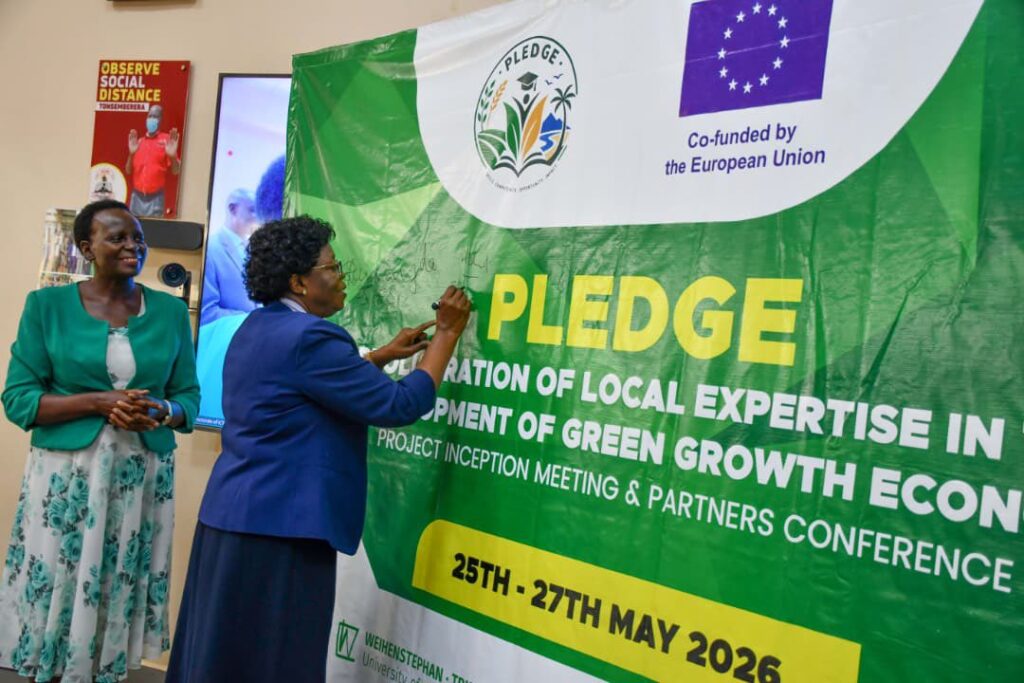
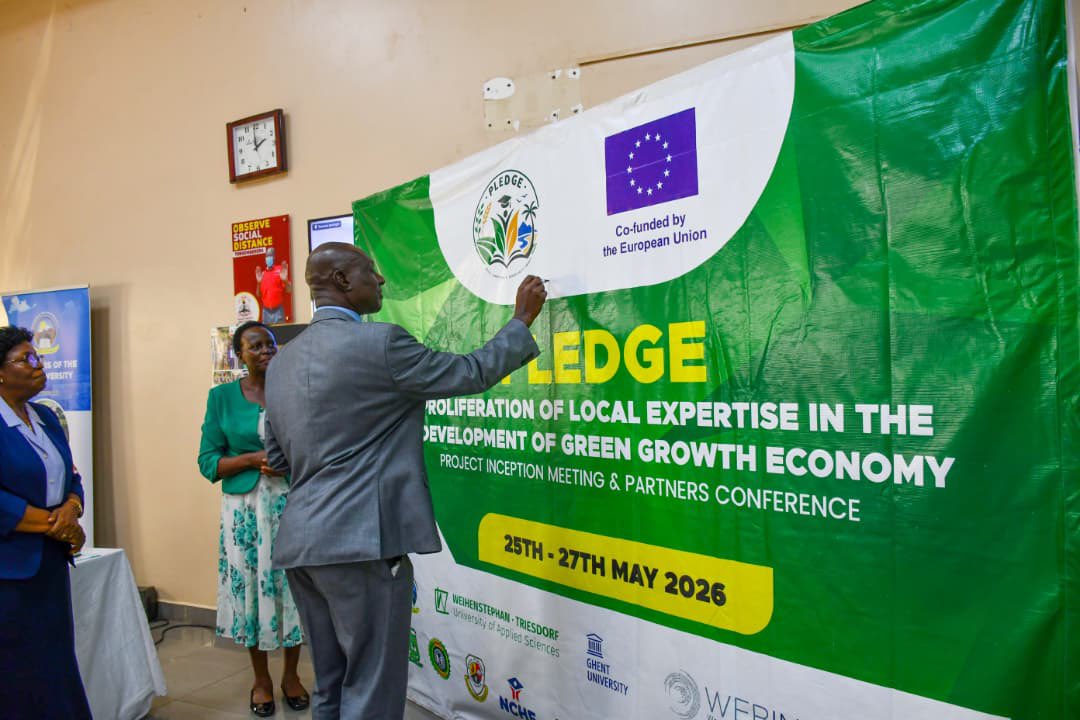

National television, radio, and online media platforms were awash with coverage yesterday and today following the landmark official launch of the PLEDGE Project: the Proliferation of Local Expertise in Development of Green growth Economy, an Erasmus+ funded initiative that positions Mountains of the Moon University (MMU) in Fort Portal as the lead coordinator of a 12 institution consortium spanning Uganda, Germany, Belgium, and Serbia.
The launch, held at the premises of the National Council for Higher Education (NCHE) in Kyambogo, Kampala, drew wide national attention as broadcasters and digital media outlets carried live and recorded coverage of an event stakeholders described as a turning point in Uganda's approach to higher education and sustainable economic development.
A Coalition for Green Growth
The PLEDGE Project brings together twelve partners committed to transforming curricula and bridging the gap between academia, government, and industry. The consortium includes Hochschule Weihenhenstephan-Triesdorf (HSWT) of Germany, Universiteit Gent of Belgium, Western Balkans Institute (WEBIN) and Univerzitet u Kragujevcu (UniKG) from Serbia, alongside Ugandan institutions including Uganda Martyrs University (UMU), Bukalasa Agricultural College (BAC), the National Council for Higher Education (NCHE), the Ministry of Agriculture, Animal Industry and Fisheries (MAAIF), Management Institute of Science and Technology Limited (MIST), Biosyntec Uganda SMC Limited (BIOU), and the Ministry of Education and Sports (MoES).
At its core, the project aims to modernise academic programmes in high growth sectors including coffee, horticulture, tourism, and sustainable agriculture. Central to its methodology is Competence Based Education and Training (CBET), which prioritises practical, hands on learning over purely theoretical instruction, equipping graduates with skills directly applicable to green jobs and environmental stewardship. The project will also foster academic exchanges and partnerships with European institutions to deepen intercultural learning and research capacity.
NCHE Executive Director Prof. Mary J. Okwakol, who hosted the launch at the NCHE premises, affirmed her institution's unwavering commitment to the project's full implementation.
"NCHE as a partner in the implementation of the PLEDGE Project remains committed to its implementation to the letter, especially in the area of policy," Prof. Okwakol stated. She expressed profound appreciation to the European Union for funding the initiative and commended MMU for its leadership in coordinating the consortium.
MMU Vice Chancellor Prof. Pius Coxwell Achanga, expressing gratitude to all partner institutions, thanked Prof. Okwakol for the generosity of hosting the launch at NCHE. He was particularly encouraged that the Ministry of Education and Sports had formally signed the consortium agreement, a development he described as a strong signal of institutional ownership.
Prof. Achanga used the occasion to highlight the structural agricultural challenges the project seeks to address, pointing to Uganda's deteriorating land tenure system as a critical constraint.
"Land is being cut into increasingly small pieces that can no longer support massive agricultural production," he observed, noting that the PLEDGE Project is specifically designed to develop the expertise and institutional capacity to tackle such systemic issues through education, research, and industry collaboration.
The Permanent Secretary of the Ministry of Education and Sports, Dr. Kedrace Turyagyenda, delivered a keynote message that set a high bar for accountability in the project's execution.
"The value of the PLEDGE Project will be measured by the quality of its implementation, institutional ownership, improved teaching, relevant research outputs, and partnerships that continue far beyond the project life," Dr. Turyagyenda said. "That is how education can truly become the driver of national development and transformation."
Her remarks underscored the Government of Uganda's expectation that the project deliver outcomes embedded within institutions long after its formal conclusion.