
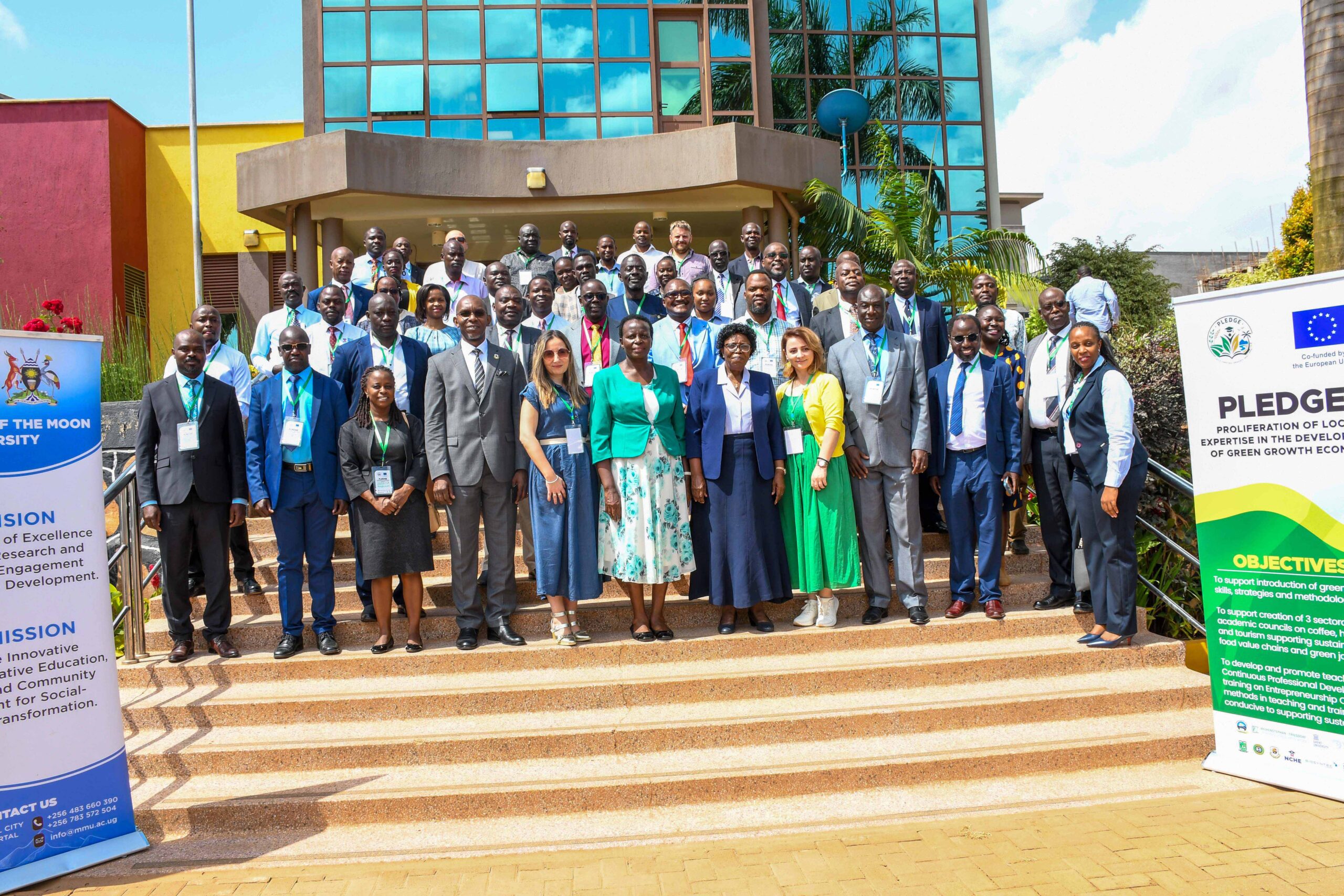

Four days after it began, the PLEDGE Project launch and Stakeholders Conference on Competence Based Education and Training closed with an awards ceremony recognising the partners, presenters, and panelists who shaped the week, and a closing address that set out what the government expects from the project going forward.
Recapping the week
Prof. Pius Coxwell Achanga, Vice Chancellor of Mountains of the Moon University, opened the closing session with a recap of the full launch week for the benefit of the chief guest, Mr. Ofwono Willy Osinde, Principal of the Fisheries Institute, who represented the Permanent Secretary of the Ministry of Agriculture, Animal Industry and Fisheries.
Prof. Mary J. Okwakol, Executive Director of the National Council for Higher Education, followed with remarks describing the conference as a rich and well thought out discussion on Uganda's path into the green economy. She thanked the European Union for its support and the international partners for choosing to invest in Uganda, then highlighted a set of standing commitments from NCHE: that university farms should be run practically and profitably, that universities are expected to act as problem solvers by asking communities and industry what problems need solving, and that the standards and templates NCHE has developed for CBET are already available to institutions and should guide their transition.
She was clear that NCHE's minimum standards leave room for innovation, and that genuinely useful innovations coming out of the PLEDGE partner institutions will be incorporated back into national standards. She also pointed to a concrete new avenue for industry engagement: NCHE's partnership with the Private Sector Foundation Uganda, which brings 230 member associations and corporations into reach for higher education institutions looking to strengthen practical training.
Remarks from the Ministry of Agriculture
Representing the Permanent Secretary of MAAIF, Brig. Kasura, Mr. Ofwono Willy Osinde closed the workshop with an address that placed PLEDGE inside the government's wider strategy for the sector.
He acknowledged that government resources are never enough to cover every need on their own, which is why the government has moved to a programme based approach, with projects like PLEDGE designed to supplement, not replace, government investment. On extension services specifically, he outlined a set of concrete government commitments already underway: recruitment of up to 2,000 additional extension workers in the coming financial year, the establishment of a District Adaptive Research Support Team to translate extension knowledge into a form farmers can use, and the recent distribution of vehicles and motorcycles to re-tool existing extension staff.
He was direct about what PLEDGE is being asked to deliver. Agriculture, he said, can no longer be treated as a subsistence activity confined to lecture rooms and offices. Unlocking the sector's potential requires graduates equipped not only with academic knowledge but with practical competence, technological expertise, entrepreneurial skill, and the ability to innovate within agricultural value chains that are constantly evolving.
He called on Ugandan agricultural higher education institutions to produce graduates with green skills and digital capabilities, to strengthen ties between industry and academia, to advance climate smart agriculture, and to generate research that is locally relevant to Uganda's farmers. He closed with a challenge that captured the spirit of the whole launch week: the time has come to move from dialogue to implementation.
Awards
The ceremony itself was officiated by Prof. Achanga, assisted by the chief guest, members of the MMU University Council, and the Deputy Vice Chancellors. Awards were presented to the guests of honour, the Executive Director of NCHE, the keynote speaker, panelists, presenters, and consortium members, in recognition of their contribution to a launch week that organisers and stakeholders alike described as a turning point for Uganda's higher education sector.
The conference was officially closed by the Permanent Secretary of the Ministry of Agriculture, Animal Industry and Fisheries, bringing four days of discussion, field visits, and planning to a close, and marking the true start of PLEDGE Project implementation across its twelve consortium partners.